.jpg)
PRICE INFORMATION
Learn more about what makes up your electricity charges, why prices change, and how to understand your bill.
WHY DO PRICES CHANGE?
Electricity has a complex journey before it reaches your home — from generation at power stations through to national transmission, local lines, and metering. The cost of building, maintaining, and upgrading this infrastructure changes over time. These changes affect the cost of supplying electricity to your home.
WHAT DOES AN ELECTRICITY BILL PAY FOR?
CHANGES TO LOW USER PLANS
Since April 2022, the Government, with support from the electricity sector, has been gradually removing the Low Fixed Charge Tariff. This change aims to create a fairer, more equitable system in the long-term. Learn more about the low user phase-out.
If you’re struggling to keep on top of your bills, we’re here to help. We'll work with you to find the right payment solution so that you can focus on what matters most to you. Check out ways we can help.
Understanding your Bill charges
In the electricity section of your bill, you can view a breakdown of how your different charge types are calculated based on your prices, usage, and days in your billing period.
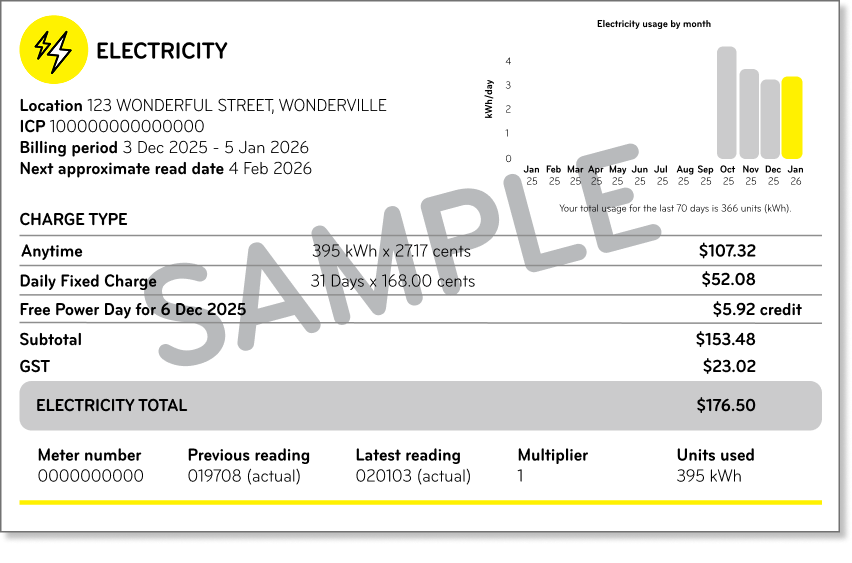
The actual electricity you’ve used. This is calculated by multiplying each unit you’ve used (kWh) by your variable price.
Tip: Variable charges depend on the type of meter tariff/s you have at your property e.g. Anytime or Controlled.
A fixed amount each day, no matter how much electricity you use. This is calculated by multiplying your daily price (cents) by the number of days in your billing period.
You may see your new prices on your first bill after the effective date. It depends on your billing cycle. As your prices change, you may see two sets of charges; charges at your old price, and charges at your new price. After this, your bill will appear as normal.
HAVE A QUESTION?
If Mercury were to absorb these costs, it would impact the amount we can put towards investment in new renewable electricity generation, which is key for New Zealand's future as people use more renewable electricity in their daily lives.
We have completed or are nearing completion of around $1 billion of investment in new renewable generation. This is across three major builds—the Ngā Tamariki Geothermal Station expansion and the Kaiwera Downs 2 and Kaiwaikawe Wind Farms.
We also have plans to invest $590 million in hydro refurbishment over the next decade.
We reinvested half of our Half Year 2026 earnings into new and existing renewable assets. These investments are making a meaningful difference to Aotearoa's energy future.